The E-3 features the world’s fastest* auto-focusing speeds thanks to an advanced AF system and new ZUIKO DIGITAL SWD (Supersonic Wave Drive) lenses. Matched with shutter speeds of up to 1/8000th sec. and 5fps sequential shooting (with a 19 image RAW buffer in burst mode), the E-3 gives photographers a crucial edge to help capture that decisive shot.
Ensuring the best image quality in the widest range of situations, this new professional model also incorporates a powerful built-in image stabilisation system which is capable of compensating against the effects of camera shake to the equivalent of up to 5 EV steps. This is complemented by a 10 Megapixel High Speed Live MOS sensor and Olympus’ TruePic III image processing engine. Together with the ZUIKO DIGITAL lenses – which are custom-made for the needs of D-SLR photography – photographers can rely on optimal results each time.

Meanwhile, the camera’s Live View capabilities provide the freedom to shoot with more versatility: Whether wanting to keep eye-contact with the subject or shooting above the head or close to the ground, compositions can be framed with ease on the 2.5”/6.4cm multi-angle HyperCrystal LCD, which also faithfully displays the effect of camera adjustments in real time.
In addition to Live View, photographers can also choose to use the camera’s large viewfinder which provides 100% coverage. Like all Olympus E-System cameras, the E-3 incorporates the most effective dust reduction system available – the Supersonic Wave Filter. Reliability of the camera system is further heightened under all types of shooting conditions thanks to dust and splashproof protection of both body and most E-System lenses. Moreover, a shutter life of 150,000 operations guarantees that the E-3 will tolerate the treatment of even the most active photographer with ease.
The Olympus E-3 will be available from the end of November 2007. The body only will be available for approximately £1099, the kit with the 14-54mm lens for approximately £1499 and the kit with the new 12-60mm lens for approximately £1699. For further information call 0800 0720070 or visit www.olympus.co.uk.

World’s Fastest Autofocus
When it comes to measuring camera speed, autofocus is a key factor. If a camera’s AF system does not meet photographers’ demands and lock focus accurately and quickly, they will miss shots regardless of the camera’s shot-to-shot speed or start-up time. The E-3’s new AF system is the world’s fastest in combination with the ZUIKO DIGITAL SWD ED 12-60mm f2.8-4.0 lens, to ensure fast focus for clear, sharp photos. Additionally, every lens attached to the E-3 benefits from faster AF, not just the SWD lenses, so the E-3 can lock focus on a fast-moving subject and capture that once-in-a-lifetime shot. The secret to the camera’s high-speed focusing is a unique Twin cross type (fully biaxial) 11 point AF sensor, based on proprietary Olympus micro-sensing technologies, that achieves equally effective performance on both the vertical and horizontal axis. With most biaxial sensors, performance on the vertical and horizontal axes is not equal, and there is often a perceived difference in response time when using different lenses. However, unlike systems that respond at nominally lower f-stop values simply by boosting sensitivity, the E-3’s AF sensor features a totally redesigned hounds tooth-pattern phase detection sensor layout that uses micro-lamination technologies to achieve superior real-world performance.
AF accuracy is further ensured by precise alignment of the optical axis from the lens to the AF phase detection sensors, and accurate mounting of the sensors within the AF unit. The AF unit used in the E-3 is made of high-tensile engineering plastic, which is further protected by the camera’s high-rigidity magnesium body. In addition, data from a dedicated temperature sensor is used to compensate for changes in operating temperature.
The 11 AF target points on the E-3 can be selected to work individually or dynamically in combination with adjacent target points. Once a photographer knows the general direction of a moving subject – a Formula One racecar zooming around a track for example – the AF area can be selected based on the anticipated motion to maintain accuracy.
The newly developed Olympus Supersonic Wave Drive (SWD) lenses on the E-3 enable auto focusing at ultra-high speed with precise and quiet operation. Quietness is essential when shooting in a situation where silence is truly golden, such as photographing exotic birds up close in the wild or musicians at a classical music quartet. But this technology truly shines in combination with three new Olympus ZUIKO DIGITAL SWD lenses that employ Supersonic Wave Drive motor technology inside: the ED 12-60mm f2.8-4.0 SWD (24-120mm equivalent); ED 50-200mm f2.8-3.5 SWD (100-400mm equivalent), and the ED 14-35mm f2.0 SWD (28-70mm equivalent). The new ED 50-200mm f2.8-3.5 SWD lens focuses twice as fast as the previous ZUIKO DIGITAL lens with that focal length, and the new ED 14-35mm f2.0 joins the existing 35-100mm f2.0 (70-200mm equivalant) as the brightest lenses in their class. Mechanical focusing is also available for easy and accurate manual focusing by hand.
The E-3 can capture images at the highest image-quality setting at a rate of 5 frames per second. With shutter speeds of up 1/8000 second, it is possible to freeze action when photographing a cheetah in fast pursuit across the plain, or a fastball before it connects with the bat.
Superior Image Quality: Steady As It Goes
To prevent image blur caused by camera shake, which can occur in dim lighting or with longer telephoto lenses, the E-3 employs In-body Mechanical Image Stabilization, which compensates for camera movement up to 5 steps EV and delivers blur-free images taken with any of the ZUIKO DIGITAL lenses available for the camera. Moreover, built-in SWD Image Stabilization offers the advantage of image stabilization for every lens attached to the camera body, so there is no need to purchase image stabilized lenses at a premium price.
At the heart of the built-in image stabilizer unit are the Olympus-exclusive Supersonic Wave Drive motors with excellent responsiveness and control. The motors use information about camera shake gathered by a gyro sensor that detects and analyzes hand vibrations, and move the image sensor with a piezoelectric element.
The E-3’s high-performance Live MOS image sensor delivers excellent dynamic range, accurate color fidelity, and a new state-of-the-art amplifier circuit to eradicate noise and capture fine image details in both highlight and shadow areas.
The camera’s Live MOS image sensor is complemented by Olympus’ TruePic III Image Processor that produces crystal clear photos using all the pixel information for each image to provide the best digital images possible with accurate natural color, true-to-life flesh tones, brilliant blue skies and precise tonal expression in between. TruePic III also lowers image noise in images shot at higher ISO settings, enabling great results in low-light situations.
Swivel Live View LCD: What You See Is What You Get
Olympus Live View empowers users to easily compose their subjects live on the LCD and see precisely how the settings they select impact the image before the shutter is released and the image is captured. By altering settings like white balance and exposure, and visually confirming how these changes affect the final image, this real-time monitoring offers a level of versatility and creative control that cannot be achieved by other digital SLR cameras that only offer an optical viewfinder.
The E-3’s 100 percent accurate swivel Live View HyperCrystal™ LCD can be rotated freely so photographers can compose with the camera held overhead or down low, enabling them to take shots from angles impossible until now without feeling like a contortionist. Because Live View enables an E-3 photographer to communicate face-to-face with subjects and still have everything in the frame with the camera body out of the way, an encouraging smile or wink of the eye can be used with a shy or nervous subject to get the desired results.
Live View provides an advantage for everyone who enjoys taking extreme close up macro shots, when composing on an optical viewfinder may be awkward, because it provides a magnification of the subject right on the LCD by a factor of 5, 7 or 10 times for sharp, pinpoint focus. The E-3 will also enable photographers to see over barriers because its swiveling LCD panel keeps subjects in view even with the camera held overhead.
The bright 2.5-inch adjustable LCD displays 230,000 pixels in vivid color and includes HyperCrystal™ technology, which offers many times the contrast of conventional LCD monitors for easier viewing in both preview and playback. It also provides a wide viewing angle of 170 degrees, which ensures images can be composed from even the most obscure angles. The 2.5 inch LCD makes viewing icons and text on the camera’s menu a squint-free process.
Reliability: Built for Adventure
The E-3 employs a large, easy-to-see optical viewfinder with 1.15x magnification and 100 percent accuracy. Photographers can rely on the E-3 to capture exactly what they compose through the optical viewfinder, so they aren’t disappointed when viewing images back at the computer. This optical viewfinder also both reduces eyestrain and makes manual focusing easier.
Olympus’ proven Dust Reduction System produces spot-free photos with the exclusive Supersonic Wave Filter™. The patented ultrasonic technology physically vibrates to remove dust and other particles from the front of the image sensor, and captures the debris on a special adhesive membrane every time you turn on the camera. It can even remove dust attached by intermolecular force that cannot be removed by physical vibration or by discharging static electricity. These spot-free photos liberate users from hours spent retouching photographs at the computer or sending their cameras back to the manufacturer to remove dust trapped inside.
The E-3 is the ideal combination of strength and mass, and was built with a new casting technology to create a stronger magnesium chassis for greater durability. The camera is also sealed to make it splash-proof and dust-proof, and when used with Pro lenses it is sealed from the elements to perform in the most rugged conditions. Its classic penta-mirror design is portable enough to comfortably shoot with all day, and measures 5.59 inches (142mm) by 4.56 inches (116mm) by 2.93 inches (74.5mm), excluding protrusions, and weighs 28.2 ounces (800 grams) body only. Photographers will experience unparalleled ease of use – from menus that make sense and buttons on the body that are easy to understand and operate for total manual control, to customizable settings for every imaginable situation. Moreover, the camera’s durable shutter mechanism is rated up to 150,000 cycles, so it will withstand heavy day-to-day use.
Accepting both CompactFlash Type I & II, UDMA, Microdrives and xD-Picture Cards, the camera provides a choice of data storage options for enhanced flexibility, and it is possible to transfer image files from one card to the other right inside the camera.
Extending the Power of the E-System with New Accessories
To coincide with the launch of the E-3, Olympus is releasing several new accessories for the E-System. The HLD-4 Power Battery Holder can hold up to two Lithium Ion BLM-1 batteries to extend the performance life of the E-3 and its existing BLM-1 battery. It also enables effortless vertical shooting with its own separate shutter button, two control dials, and dedicated Function and AF target buttons. Like the E-3 body, the battery holder is splash-proof and dust-proof to endure severe climates.
The FL-50R and FL-36R are new wireless electronic flashes designed exclusively for digital photography. Their light emitting and brightness control circuitry achieve uniform illumination in the picture area and high brightness control accuracy. Both flashes have a rotary head that can be rotated in four directions. When these flashes are used in combination with the E-3, which features a commander function incorporated in its built-in flash, wireless multi-flash photography is possible without using an outside commander. The E-3 can control up to three wireless flashing groups independently, and control of multiple flashes is possible even in an environment in which both the FL-50R and FL-36R coexist. In addition, the centralized control/display system makes it possible to enter and check all of the selected items on the E-3’s Super Control Panel LCD. This ensures excellent operability and mobility.
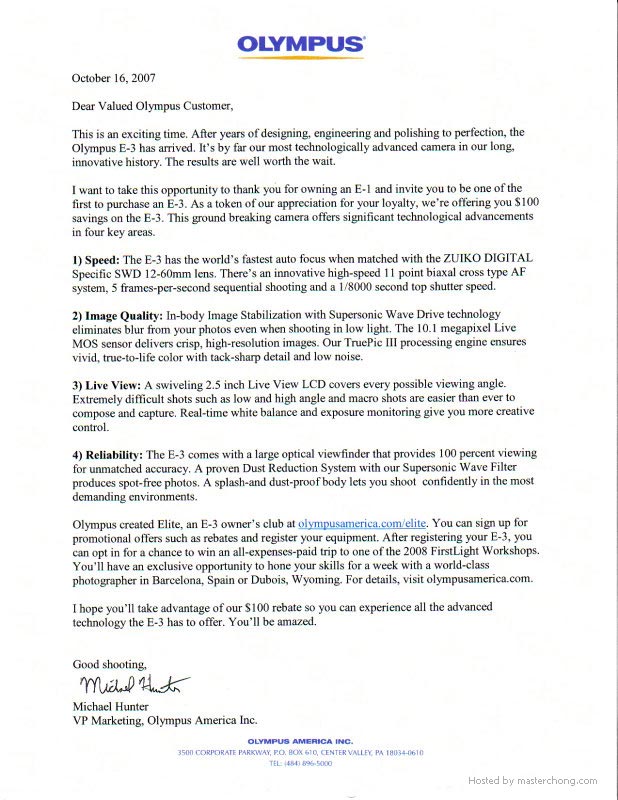
A letter by Michael Hunter, VP Marketing, Olympus America regarding Olympus E-3 courtesy of Glen Smith
Coutesy: Pchome.net
{mos_ri}




Be the first to comment