Canon to Solve 5D Mark II Black Dot Issue
December 13, 2008
Canon
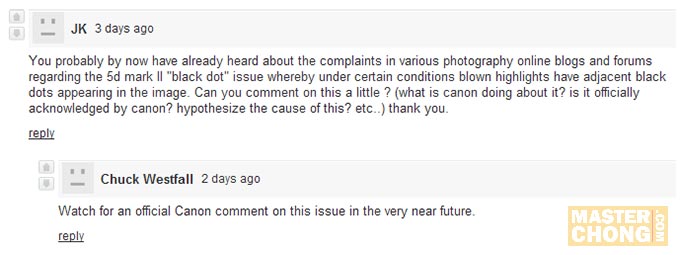
A number of internet discussion board and portal are talking about the Canon EOS 5D Mark II Black Dot issue. The issue mostly occurs during nighttime landscape photograph. Some new users of the first Canon HD movie recording capable DSLR reported that the issue occurs in higher ISO level. However, there are discussion about the black dot issue when using low ISO setting such as ISO100.
Canon to Solve 5D Mark II Black Dot Issue
The exceptionally low noise of the D3X is essential to any professional commercial application, and it provides photographers with an ISO range of 100 to 1600, expandable to 50 (Lo-1) and 6400 (Hi-2).
The ultra smooth tones and lack of grain at ISO 1600 as well as at low sensitivity settings result in smooth, natural skin tones and exacting detail that, before the D3X, required larger and far costlier studio-bound camera systems.
1/125 second f/5.6 70mm ISO 6400 AF-S Nikkor 24-70mm F2.8 G ED
Mark Goldstein from PhotographyBlog published an in-depth review about Canon’s latest semi professional full frame digital single lens reflex. His review covers the 5D Mark II’s ease of use, how is the image quality and ISO performance. Sample photos are available too for reference purpose.
Image Quality: There is no discernible noise between ISO 100-1600, and ISO 3200 also looks very good. Noise is more apparent at ISO 6400, becoming progressively worse at ISO 12800 and the fastest setting of ISO 25600, but it’s still very well controlled with images suitable for small prints.
There’s virtually no visible noise at all from ISO 50 all the way up to ISO 3200, with even the three faster settings of 6400-25600 producing perfectly usable images. Canon seem to have matched the low-light performance of the Nikon D3 and D700 whilst substantially increasing the resolution.
Comparison: The 5D Mark II doesn’t stack up too well in terms of continuous shooting speed or autofocus points when compared to the Nikon D700, and viewfinder coverage to the Sony A900, so you still need to carefully consider what you’ll be mainly using the camera for. It definitely offers more than enough new features and handling improvements to tempt original 5D owners to upgrade, substantially refining what has proven to be a big hit for Canon.